
NOVEMBER RANGER, 75th INF
61ST AHC, 1ST AVN BRIGADE
“Operation
Bright Light”
A
few years ago I met Carl Millinder on the Internet while searching for pilots I
flew with and trying to make some contact with people I had served with.
Carl responded to one of my inquires and we compared notes.
Both of us were in country in 1971, Carl with the N Rangers 75th
Inf. at LZ English, and myself with the 61st AHC at
This
mission “Operation Bright Light” took place Feb. 1971.
“Bright Light” was a code word used to designate operations and
intelligence relating to POW’s and down aircraft. To have some idea of the
impact of the mission and why I remember it so clearly, first this was a
historical mission, or at least it would have been if it had been successful.
And secondly, I was on my second tour and the new platoon commander for 2nd
platoon. My first tour was in 1968 with Casper Aviation Platoon HHC 173rd
ABN. I took some comfort with
being familiar with the Area of Operation and supporting the 173rd,
but not all that familiar with my new position, or comfortable with being the
new guy (FNG) in the unit.
Being
woken up at
We were
to follow the river West from LZ Pony past LZ Abby turning North at an area
called “crows foot’ and continue to follow the river.
The flight was low level. North
on the river there is a large waterfall, about 200-ft. high.
I had seen it once before in 68. As
we climbed to get over the waterfall we were to continue to follow the river and
keep climbing to an altitude so that we could see the LZ, which was to the South
of the river. The waterfall
was our IP.
The
final destination was about 24 miles north of An Khe and about 14 miles West of
LZ Pony. I don’t know the last
time Americans had been in this area. It
could have been at least 4 years, truly Charley country.
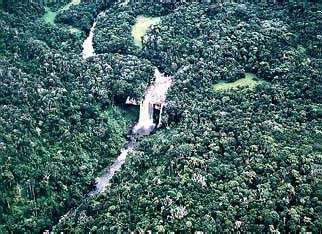
Picture by Ken Thomas “
We were
issued gas mask to use during the initial insertion.
They were designed for air- crews so had to be plugged into the
intercom/radio and the can/filter was on a long hose and strapped to your body
or leg. The lens were a thin plastic
and hard to see through and in my case there was a wrinkle which distorted the
view, such that I could either see two trees where there was one or see none at
all with out moving my head back and forth.
I don’t know who was responsible for the gas mask, but there was only
enough for two per ship. There were 4 crew per ship and with only two gas masks
there was cause for concern. There
was no way the mission would be delayed or cancelled, so each ship decided who
would wear the mask. In our case the
decision was that I would wear the mask along with the crew chief.
The AC would fly the ship into the LZ and as the gas came into the ship
and he was affected by it I would take over and fly out.
I think Mr. Hahn would have preferred a more experienced pilot with him
in the lead ship, however he never said so.
The LZ
was tight so to fit all 5 ships in we had to crowd forward so our blades were
over lapping an old bunker. It was
over grown and we didn’t see it till just before we set down.
There was an opening in the bunker immediately to my front about 20 feet
away. Our orders were not to return
fire to prevent accidentally hitting any of the POWs, despite the order I had my
.38 out and was ready to shoot thorough the windscreen if I saw any movement in
the bunker. The time in the LZ was
very short, the crew chief said we were clear, which meant that all the Rangers
were out. We came to a hover and the AC radioed the flight that “lead is up”
and I heard trail respond that “the flight is up”, there was no other radio
talk. As planned the AC said,
“you’ve got it”. Excited and still new I pulled pitch, and forgot the left
pedal. We listed right and were
going out of the LZ sort of side ways, I heard someone, maybe the crew chief or
the AC in the intercom yelling left peddle, which solved our problem.
There
were no rounds fired, no one was home. Back
at LZ Pony we were waiting for information on our next step.
Fly in the reserves, or fly in and pick up the POWs and the Rangers.
The call came that there were no POWs and that we were to fly back and
extract the Rangers. This was a
major disappointment, and the reason why no rounds were fired.
Our good fortune of not having a hot LZ was very bad news for the POWs.
They had been there, and had been moved as we were coming in.
Carl told me that they found the cages they had been kept in. E-mail from Carl, “We knew there were plenty NVA that was supposed to be there. So we were a little concerned. Wrote the goodbye letters and shit. Sorry we didn't find the guys. We knew they were close.”
Carl also sent me this: “As I remember the mission, was
to have four ranger teams inserted at the
I think the mission on the ground lasted about an hour. We were picked up, flew back to English and debriefed. We still never knew where we had gone.”
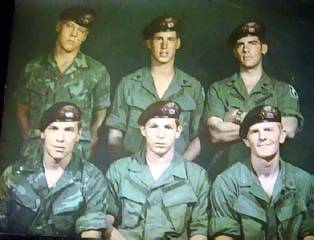
Charlie team N Ranger, 75th Inf.:
Standing left to right…Thomas Oulett, Carl Millinder, and Donald Valencourt
Sitting left to right……Wayne Galbreath, Mike Staffin, and Dennis Russel
As Carl and I communicated I was surprised to find out that the Rangers didn’t
know where they were going. Plus that they were expecting to be inserted at the
corners of the grid, however there was only one LZ, which would fit in the
flights or a single ship and that, was in the old firebase.
I was also surprised to find out they had trained for the mission and we
had almost no notice.
In one of his e-mail messages Carl said:
“I had a guy
working on an oil rig 20 years or so ago that was a POW. I told him about the
mission, and the water fall. He told me he was one of the guys that built the
bridge across the river. I don't remember his name but we called him Snuffy. I
didn't remember a bridge at the time. But, I see it in the picture. He told me
they had moved underground just before the gas hit. Wow. Gives me chills.”
We are left to wonder what the outcome was for the POWs.
The
I would like to believe that the POWs made it North and
were released. However we may never
know that for sure. Carl’s
experience of meeting “Snuffy” would leave me to hope so.
Carl’s and my memory needs some help, so if anyone else
in the 75th or the 61st that remembers this mission would
like to add to or correct this narrative please get a hold of either one of us.
I had most of a full tour left, and as the skills of the
peter pilots improved and the current AC’s rotated back to the states we
became Aircraft commanders. From my first tour with the 173rd ABN I
had gained a great deal of respect for the LURP, which they were called in 68,
but in 71 I got to fly more missions either inserting or extracting the Rangers.
I was always in awe of their missions and how they carried them out.
The Rangers should know when we knew we were going to be flying N Rangers
that the 61st took the missions very serious.
The best pilots were assigned, with one of our better ships.
These missions always seemed to prove challenging.
However most of the time we would be assigned to fly C&C for one of
the Battalions and during the day we would find out that a Ranger team needed to
be inserted or extracted. At one
time or another all our pilots got to fly these missions.
Insertions were planned and for the most part went well, however
extractions could be the most challenging and some times were on a TAC-E
(tactical emergency) so the closest ship to the team would be sent in.
These missions were the bases for many war stories.
Not to blow any smoke but I can’t think of anyone else that I would
rather be flying than the Rangers; they were the most professional troops you
could work with. They knew what they
were doing and we knew if the “fit hit the shan” you couldn’t be with a
better group.
Written By:
Carl Millinder, Charley team N Ranger, 75th Inf. www.75thrra.com
Clifford White, 2nd Platoon 61stAHC, 1ST Avn. Brigade www.61ahc.org